

The Complete Guide to Choosing Kitchen Countertops: Materials, Styles, and Costs
March 1, 2021
If you’re thinking about a kitchen or bathroom refresh and have no idea what type of countertop material to choose, this blog is for you. Bear with me as I break down your options and give you some pros and cons of each material. I’m also going to include some brand names and a 1-10 point comparison scale of how pricy each option is. In general, when selecting countertops, there are 2 main questions to ask yourself: 1) How particular you are with the appearance (aesthetics/colors)? And 2) How “hard” do you live within the space (function)?
I’ll start by categorizing countertop materials into two groups: engineered products and natural materials and then talk a bit about fabrication.
Engineered Materials
As a general rule (it doesn’t always perfectly correlate), engineered materials are more cost effective and offer more function than natural materials. They have also come a long way in recent years, making products and surfaces that are extremely difficult to discern from the real, natural thing. There are 3 main types of engineered surface products: laminate, solid surface, and processed quartz.
Laminates
These materials often conjure negative thoughts of linoleum flooring and Formica tops from the ‘70s and ‘80s, however they have come a long way in their ability to create depth, control sheen, and provide realistic patterns for countertop materials. These products are made by taking a base layer of plywood (engineered wood that holds form, resists warping) with a decorative “skin” laminated on the surface. This skin is a paper base (many are digitally printed with desirable colors/patterns) that is soaked in a liquid resin, cured at high temperature and pressure. Like most human-made products, laminates are color controlled, meaning the color on the sample is exactly the same as the full slab.
Laminates Breakdown
Benefits: Very durable to scratch/mar/abrasion; cost effective; easy to fabricate, believable looking surface; color control with hundreds of options
Weaknesses: The seams are more noticeable – giving away the appearance of “realness” (joints, corners, etc.); moisture can be an issue if allowed behind/underneath the skin to the plywood (which can warp/damage).
Price Point: 1-5 (wide ranging due to variety in quality)
Brand Names: Formica, Wilsonart, Pionite
Summary: Laminates work really well for accent walls and cabinet faces – essentially anything with a vertical application where you can control seam placement and disguise it. However, I encourage caution on high moisture surfaces near kitchen sinks or other high traffic areas due to the amount of edges/seams/corners and their susceptibility to water damage.

- Image: Formica
Solid Surfaces
Solid surface takes laminates functionality to a whole other level. This material is manufactured with resins, pigment and fillers (for strength) creating a stone-like slab. The density and thickness remove the need for a plywood backing (which as mentioned above, can be susceptible to moisture). The surface is very low in porosity, meaning it will resist stains/spills. Also, due to the nature of resin chemistry, all the seams can be fused together with a 2-part epoxy (meaning seams are much less noticeable). Moreover, resin can be fabricated with woodworking tools (meaning it can be repaired easily if damaged). If a child smears lipstick all over or someone spills a glass of wine – just re-sand and polish to restore the original look. This human-made material can be formulated with very natural looking swirls and marbling that helps avoid “pattern repeat” – a quick give-away that it’s not natural.
Solid Surfaces Breakdown
Benefits: Very durable and stain resistant; easy to maintain/repair; nice looking with realistic seaming; color control with dozens of options, moisture resistant
Weaknesses: Difficult to achieve high degree of sheen (like the gloss level of a granite for instance); must protect from heat with trivets
Price Point: 3-6
Brand Names: Corian, Avonite, Staron
Summary: I like solid surface for commercial applications because it looks nice and is super functional (it’s everywhere in airports, hospitals, restaurants). It works well residentially too, especially if you are passionate about color accuracy.

- Image: Corian Dune Prima
Quartz:
You might think, “Wait, isn’t quartz a natural stone?” – and you would be right! However countertop materials called “quartz” are actually engineered products, fusing together pulverized natural quartz with various resins through pressure and heat. Think of quartz countertops as using similar technology to solid surface but with some natural ingredients. Many manufacturers use recycled content in their resin/filler combination, making them a “green” choice. Due to the real quartz within each slab, this material can be buffed to near granite/marble levels of gloss and sheen – making them feel more realistic, without any vulnerable fissures that may exist in natural stone slabs. Quartz also has the quality control of solid surface, so each slab and sample are color accurate.
Quartz Breakdown
Benefits: Very natural-looking, highly durable/stain-resistant, color accurate with dozens of options, high granite-like sheen, recycled content
Weaknesses: Not as repairable as solid surface (must use diamond/wet tools); higher price point for an engineered product; can be damaged by heat (300ºF+) – protect with trivets
Price Point: 7-10
Brand Names: Cambria, Caesarstone, Silestone
Summary: I love quartz for the beauty and color control (you know exactly what you are going to get). It’s also probably the most durable product on the market, resisting stains and impact – super low maintenance. Gives the look of natural stone but with less fuss.

- Image: Cambria Quartz
Natural Materials
While materials like wood, stone, granite, and marble are more expensive and require some care/maintenance, I love the natural beauty and feeling of these real earth-created countertops.
Granite
Granite is all-natural geology, formed by extreme heat and pressure over thousands of years. The variety of colors, swirling textures and 3D-like appearance are all combinations of different minerals being pressed together over time. Granite is wild with lots of complexity – no two slabs are alike, which means that if you are looking for a specific color or trying to match an existing slab, good luck. Colors vary dramatically. A slab you bought a few years ago will look completely different than slabs from the same “family” that are in stock today. These families are created by importers who source the slabs from countries of origin, like the quarries of Africa, Brazil, India, and Italy. They try to batch the slabs into categories of like-colors and patterns, to allow buyers to fit them into the design process. Since no two are exactly the same, what you see on a designer’s shelf might not be fully representative of what is in stock. Granite slabs are basically big rocks, with varying degrees of porosity – meaning they can wick moisture without repair. If you leave a red wine ring on your counter overnight, it will be there forever. Aftermarket sealers can be applied to prevent this; however, it requires annual application/maintenance. Granite can also be finished with several “textures”: polished, leathered (which is more matte and subtly dimpled), honed (softer matte) and flamed (bumpy, more rustic).
Granite Breakdown
Benefits: Natural beauty (your slab is truly one of a kind); high sheen; 3D-like dimension
Weaknesses: Susceptible to stains; cannot fuse seams (must glue them together); cannot be easily repaired, must maintain/seal every year or so
Price Point: 3-10 (all based on supply and demand of the quarries – if it’s generic and plentiful, it will be lower-priced; if it’s exotic and rare – more pricy)
Brand Names: There aren’t truly “brands” but instead fabricators will use the color/pattern families provided by the importers. Like: White Ice, Absolute Black, Kashmir, & Ubatuba.
Summary: Granite is amazing if you fall for the natural beauty and uniqueness. You have to maintain it to protect the finish, however the price points have come down on many granite styles – making it potentially worth the slight maintenance burden.

- Image: Keystone Granite & Tile
Marble
Marble is very similar to granite in that it’s a natural stone from the earth. However, the geology is different. Marble is softer, less dense, and has more swirling patterns/textures. It is often very light in color, coming in whites, light grays, and beiges. It has a very high porosity (think staining) and is impressionable to impact (meaning it can dent if struck hard enough). Because of this, ancient cultures often used this material for sculpting. Marble is gorgeous – literally one of the most unique and beautiful materials on earth. Most Americans won’t buy marble for the kitchen out of fear of damage (the bright white marble looks pretty rough after getting stained with wine and food). Most US buyers put it in bathrooms instead. Like granite, this material can be sealed to protect the look, but it must be done more often. It’s worth mentioning though, that some Europeans love marble in the kitchen and install it unsealed, letting food and beverages stain away if it happens. It’s a “real life” kind of attitude – “our kitchen physically resembles our lives”.
Marble Breakdown
Benefits: Natural beauty; high sheen; unique swirling patterns
Weaknesses: Very susceptible to staining; cannot fuse seams; cannot repair and must maintain often
Price Point: 7-10 (like granite, depends on supply/demand at the importers – if you have requirements for smaller sections of countertops, ask your fabricator about “broken slabs”: these are left over from larger jobs or broken in transit, sold at discount)
Brand Names: Same as granite with the “families” versus brands: Calacatta, Carrara, Bianco
Summary: If I didn’t have kids, I would for sure choose marble in a kitchen because it’s akin to a work of art. But it’s just not functional for a young family with spills, mess and wear/tear. It’s also pricy for something that requires maintenance.

- Image: NY Times
Quartzite
This all natural stone (not to be confused with quartz) is super dense and has a much lower surface porosity than its granite and marble counterparts (less susceptible to stains). This gives buyers the best of both worlds: natural stone beauty with a more durable/functional material. Some Quartzite slabs even look like marble, with lighter shades and marbling swirls. It is often on the higher side of the price spectrum, depending on the color family.
Quartzite Breakdown
Benefits: Natural beauty; high sheen; unique patterns; hard/durable surface; more stain resistant
Weaknesses: cannot fuse seams; high price point
Price Point: 9-10
Brand Names: Same as granite with the “families” versus brands: Macuba, Matarazzo, Taj Mahal
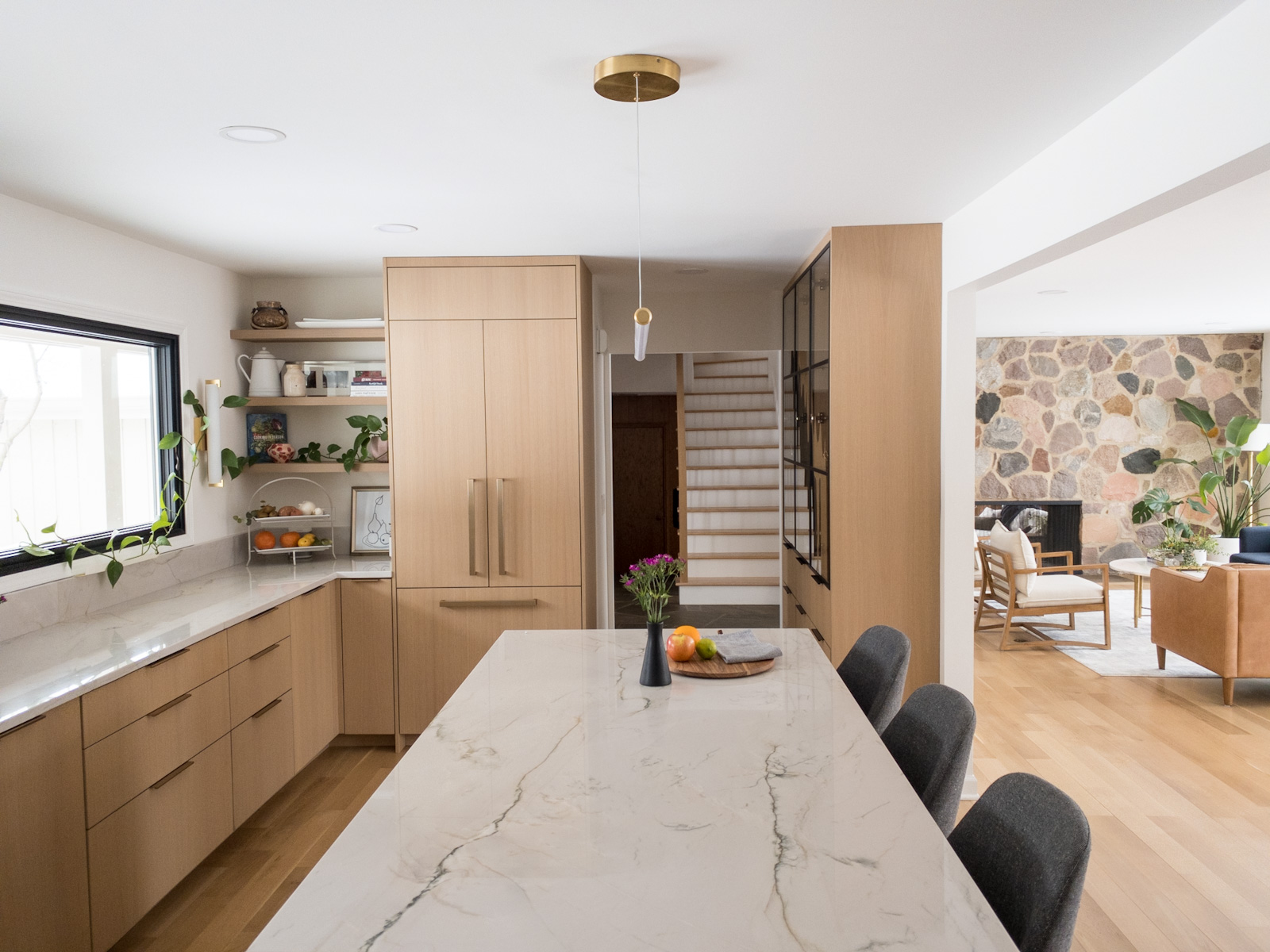
Summary: I love Quartzite. The natural, marble-like appearance paired with higher durability and functionality warrants the higher price tag. We selected a light gray quartzite with blue, green, and taupe color veining for our Highland Park kitchen remodel and are quite happy with the results. Consider how long you envision living in your home. In most real estate markets, buyers can expect to get back most of their investment when it comes to kitchen remodels – including high-end materials and finishes. However if you plan to sell sooner than later, you might choose something more in the middle price-wise, to ensure the desired return.

- Image: Our Highland Park Kitchen
Butcher Block (wood)
Butcher block is a very cool looking product that is both human-made (fabricated) and natural (real wood). It is made by cutting larger planks of wood into smaller strips (usually 2”), then each strip is turned onto its end-grain and glued/pressed into a large slab. The end-grain is wood’s most durable edge and can hold up to impact and indentation. Fabricators will finish these tops with a wax seal to lock in the fibers, so you don’t get any food bacteria growth. However, you have to reapply the sealer every year or so. They end up being pretty functional and look really cool. There are several color options due to the variety of wood species and stain colors. Any damage can be sanded down and restored.
Butcher Block Breakdown
Benefits: Natural beauty and color of wood; hard/durable surface; food safe; repairable and heat resistant
Weaknesses: scratch prone; must be sealed
Price Point: 4-6 (depending on size and thickness)
Brand Names: Fabricators like Walnut Woodworks (Tennessee, ships all over US) will offer walnut, maple, oak, and cherry.
Summary: We chose a walnut butcher block for our Chicago kitchen remodel in Logan Square. It was beautiful with vivid colors and distinctive graining. It definitely looks more industrial, so it might not be for everyone. Also, it can scratch (ours did!) so you have to be careful. For the price, it’s a nice looking and unique product.

- Image: Athena Calderone’s rental kitchen
Fabrication
If you’re still with me, I have one last point to make. Most countertop providers offer both the material and the installation, and some offer a showroom experience and outsource the install. Most engineered products like Silestone and Cambria will have authorized fabricator/dealer pages on their website. These are affiliated installers who specialize in working with that material. They also have local showrooms to view samples and full-size kitchens for inspiration. Natural stone fabricators span from people in garages to highly sophisticated production and showroom facilities. We’ve enjoyed Stone City (Chicago) and Marble & Granite Supply of Illinois (Niles) Both places have a massive selection. The difference we experienced between those two locations is that Stone City will fabricate the stone for you and Marble & Granite Supply won’t. In the case of the latter, you will need to use one of their 3rd party recommendations (which we found to be more expensive).
I hope this helps as you navigate the abundance of kitchen and bathroom countertop options available!
